Trax and AI agents
An AI agent is one more client of a process, like a person in a browser or a script. It is the one most likely to try a move it should not make, and the one least likely to follow rules written only in its prompt. This page explains where Trax sits around an agent. It assumes Trax in five minutes.
Every client gets the same rules
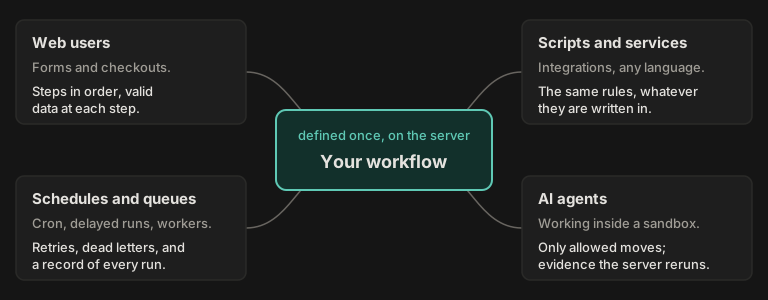
Because the rules live on the server, every kind of client gets the same ones. People in a browser get the steps in order and their input checked, through the TypeScript client Trax generates. Scheduled and queued work runs when you say; Trax queues it, retries it as often as you allow, dead-letters it when it runs out of retries, and records every run. Scripts and services call the same GraphQL API Trax serves, in whatever language they are written in, and the rules hold for them too, including the ones their language cannot check. AI agents can only make the moves you declared, and when a move needs evidence, a check you write as a train reruns it on the server before Trax accepts the move.
Where Trax sits around an AI agent
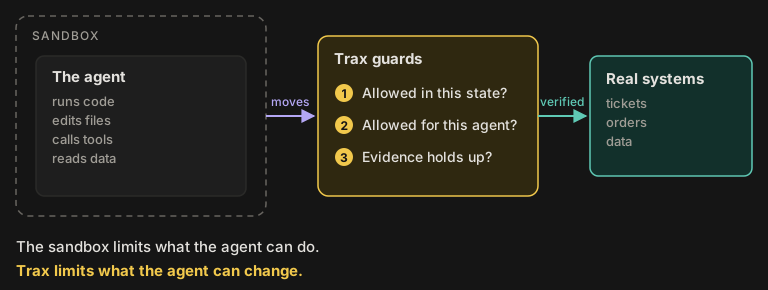
AI agents are the most demanding client. Two layers do two different jobs. A sandbox limits what an agent can do: it can run code and make a mess, but only in its own box. Trax limits what it can change: its only way out is a small set of declared moves, each checked against the state, the agent's role, and evidence the server checks itself rather than takes on the agent's word. The sandbox is not Trax; you run it with whatever tool you already use. Inside Trax, you write the rules and the evidence checks, and Trax makes sure the agent cannot get around them. Most agent setups have the first layer and improvise the second with instructions in a prompt.
The Board sample
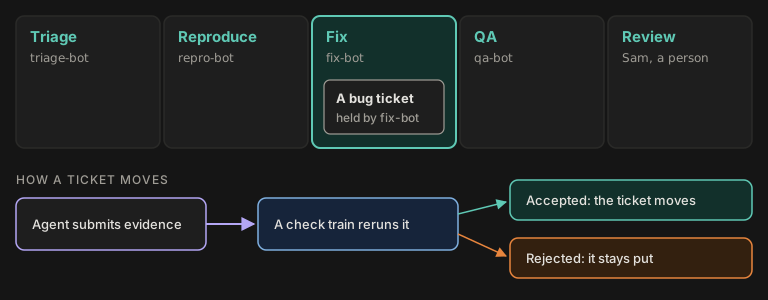
Board is a Trax sample where bots move bug tickets through lanes. Four scripted bots and one person each own a lane, with keys of their own. A bot never moves a ticket itself: it submits evidence for its lane, a check train on the server reruns that evidence against the rules, and only the train's verdict moves the ticket. The sample's author wrote one check train per lane, as ordinary trains; building your own agent workflow, those are the trains you would write. Trax is what makes the verdict the only way a ticket moves. The last lane belongs to a person, so human sign-off is just another lane with a role. The bots are scripted, not language models, but they talk to the server the way an AI agent would.
What an agent cannot do there, and what it gets back:
| The agent tries to | The server answers | Because |
|---|---|---|
| Claim a ticket another agent holds | ALREADY_CLAIMED | a claim needs a ticket nobody holds |
| Approve its own fix | FORBIDDEN | only a reviewer may approve |
| Close a ticket as not reproducible too early | GUARD_FAILED | closing needs at least two cases the server ran |
| Claim work when none is waiting | NOTHING_TO_CLAIM | there is no ticket in its lane |
An agent cannot report its own test results either: the cases on record are written only by the server's check.
Where to go next
| You want to | Read |
|---|---|
| Run the Board sample | Board |
| Decide between a train and a machine for a step | Train or machine |
| Write the rules that say who may send a move | Authorization rules |
| Point a coding agent at these docs | /llms.txt, one file that lists every page |